

There is something about the narrative in the book of Judges that can feel like a faraway story. We ought to remind ourselves that while it is a narrative, it is a historical narrative. The events here did happen it happened in real space-time history. And we should read it and feel uncomfortable.
How is the book of Judges designed? We begin by reading of how Joshua led the people in the Promised Land and as they entered, the reader should have in mind how God’s people finally entered God’s Promised Land under God’s leader with God’s presence. It may seem like everything will now be restored but we also read of how Israel does not fully possess the land as they allow some of the inhabitants of the land to remain there.
God begins to raise up judges – heroes raised by God to save His people. From Judges 3:7, the introduction of the book is now over and we begin to read of the individual stories of the judges. In this study, we will try to see what we can learn from these men.
(A) Othniel: empowered by the Spirit (Jdg 3:7-11)
Judges 1-2 establish the premise and predictable pattern for the book of Judges. We learn about the characters who, what they did and the context of their actions:
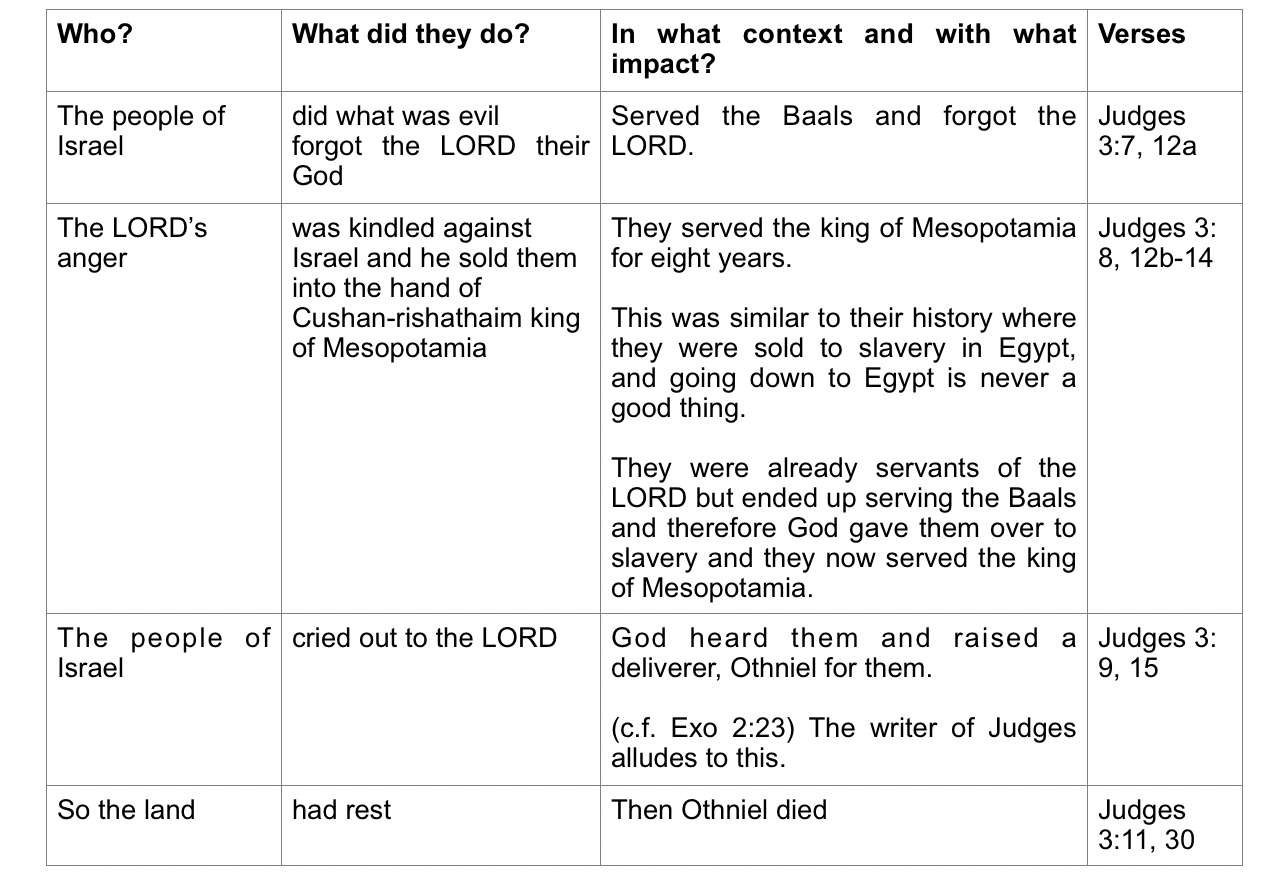
God’s people repeatedly do what is evil in His sight. It is in the sight of the Lord that they keep doing these things. Why? The text helps us to see that it is because of spiritual amnesia. The people forgot the Lord. God had previously told them to hear and be careful to keep the words of the Lord when they enter the land He is about to give them, even before they entered (c.f Deut 6:3-6).
What does it mean for us when we see their disobedience? We should look into God’s Word, which is a mirror. When we look into it, we see not the sin of others, but our own sin. Are you remembering the Lord tonight? Does it control you from your innermost being? Is His Word in your heart, in such a way that reflects your love for Him? There is no corner where God’s Word does not follow you.
Judges shows us our propensity for sin, but also God’s mercy. As we read Judges, let us see our need for grace and also God’s willingness to show grace. We should see our sin and also how wonderful God is, one who is merciful and slow to anger, and also allows us to suffer the consequences of our sin.
The 12 judges are pictures of human sin, covenant unfaithfulness and God’s enduring faithfulness that cannot be exhausted.
Othniel was previously mentioned in Judges 1:13 and we see that he is a man of great faith. In Judges 3:10, we also learn more about this deliverer that God raises up. There is one piece of information that is unique to Othniel — “the Spirit of the LORD was upon him” (Jdg 3:10a). The Spirit of the LORD being upon this man is the reason for his success. He was empowered by the Spirit and was therefore able to find success in battle because of the Spirit. What does it mean? Now, if we think that being full of the Spirit is just a moral category, we will not understand what is going on here. Yes, there is a moral aspect to being filled with the Spirit but it also means that we pursue the agenda of God for the outcome that God desires. The favour of God orchestrates circumstances and show that He is truly at work. God also grants supernatural ability (c.f. Samson later on) to these judges.
In the New Testament, we read of this same Spirit coming down not just on one individual but on all Christians. All Christians have the Spirit. This Spirit guides our volition and will and is the Lord upon us. And this Spirit never leaves us now.
Today, we can say that God’s Spirit living in and with us must mean something. Galatians 5:16-25 teaches us that we are empowered by this same Spirit who gives us the victory. We can fight sin and fight for holiness and righteousness.
(B) Ehud: the surprising savior (Jdg 3:12-30)
We now read of Ehud the Benjamite (Jdg 3:15a). Ehud is not a normal saviour. God usually delivers with His outstretched right hand and now we are told that he is a left-handed Benjamin. He fashions a sword with two edges and also presents a tribute but does not present it himself (Jdg 3:16,18). He places the sword on the right, which goes against convention. The writer of Judges wants us to know that he was being underestimated, and the king therefore allows him to approach.
He was an unexpected deliverer.
This whole narrative in Judges 3:15-25 is highly absurd and the readers are left feeling slightly uncomfortable. We need to remember that the Bible s not a collection of moral sayings and neither does it just show heroes we should emulate. Ehud is probably one character we should not be like. God’s Word, being God’s Word, should not conform to the caricature of what the Bible should be in our mind. The God of Ehud is the same one who can bring victory out of defeat and life out of someone’s death. He is a God who continues to surprise us.
The book records his preparation, his approach and some of the initial failure in his plan. Mysteriously, he is granted access and the conditions are granted him for success. We see human weakness and vulnerability in the detailed description of Eglon’s death. It appears to be a dishonourable act of some moral ambiguity.
If it is true that Ehud is a man of disability and an unexpected saviour, it is more remarkable that he is able to summon Israel to unite together. He merely goes to the people and call them to follow him, for the LORD has given their enemies into their hands (Jdg 3:28). He invokes this covenantal name of God and the people can go into battle confidently because God is with this unlikely, left-handed man who is their leader. The people seemed to have absolute control over the Jordan and Israel was able to defeat 10000 Moabites, “all strong, able-bodied men; not a man escaped” (Jdg 3:39). God had granted a surprising, comprehensive victory.
(C) Shamgar: strong to save (Jdg 3:31)
Ehud killed 600 of the Philistines with an oxgoad (Jdg 3:31). This agricultural worker with this tool slain 600 men. He was not a professional soldier and his name is not a Hebrew name but was likely named after a Canaanite deity. His parents were probably unfaithful Israelites. We do not know his whole backstory but we know that God used even him to achieve a tremendous victory against the Philistines.
Shamgar, like Ehud, was a surprising saviour.
God alone is God. He is sovereign in His wisdom. He chooses who He wants to achieve the victory. He saves who He pleases so as to bring glory to Himself. The greatest sign of this is not Shamgar or Ehud, but the victory of the cross. God does not use glory to bring glory but shame and defeat to exalt His Son.
He uses death to bring about life.